1. Common camera angles, shots, and movements in the film "Us":
- Close Up: The close up shots were mainly used to show the reactions of the actors after something shocking happened.
- Long shot: This shot was used to show everything on the actors body from head to toe.
- Tracking shot: This track showed the characters being followed by the camera throughout the movie
- Over the shoulder shot: This shot was used to build up suspension throughout the movie
- Establishing shot: This shot was used to set the scene
- Low angle: This angle showed the floor view of the victims being killed
- Reaction shot- This was used to show the actors reactions to events that happened throughout the movie. For example, when the evil family revealed their faces this shot was used to show the families reaction.
- Reverse shot- This was used to show the characters speaking to one another.
- Eye-line match- When the mother would look at the other family this shot showed her reactions.
2. Common CLAMPS / "Mis En Scene"
- Costume: The costume for this movie is a red tethered jumpsuit that looks similar to what prisoners wear except it was red.
- Lighting: The lighting in this movie was based off the time of day. For example during the day the lighting was bright and during the night it was dark so the actors weren't able to be seen as much as they normally would be seen in the daylight.
- Actors: The actors in this movie played the role of the antagonist and the protagonist which is why this movie was so unique. They played both roles because there were 2 of the same families from different places. One of the families were able to speak and the other family couldn't speak at all, other than the mother.
- Make up: Make up was used to create burn marks on one of the actors faces which could be considered as a special effect.
- Props: The main prop used in this movie was a pair of scissors that was carried by the antagonist throughout the movie.
- Setting: The setting of the movie took place at an old cabin and a pier where the mother grew up as a child.
3. Common Sound
-Diegetic sound: The diegetic sound in this movie mainly occurred outside. For example, at night time you were able to hear the crickets outside.
- Non diegetic sound: Sound effects were added when things were blown up such as the car scene.
- Dialogue: There was conversation throughout the entire movie.
- Incidental Music: This type of music was added in the scary parts of the movie to create suspense
4. Common editing in the movie
- Cutaway
-Action match
Reaction shot
Reverse shot
Eye-line match
5. Elements of this genre
- There is ongoing conflict and multiple plot twists.
-There is a lot of suspense.
- There are a lot of things that got in the way of the family escaping.
- You get a huge climax.
- There's always a surprise ending that leaves you questioning everything.
6 and 7: Elements that you do and don't like
- Our group likes all of the elements that come with the thriller genre because you never know when and where something is going to happen. The feeling of suspense keeps us interested in the movie which is a good thing from an audience members perspective. If we had to chose one thing that we didn't like it would be the surprise ending because some endings are confusing and they take a while to understand.
Sunday, January 26, 2020
Genre Research: The PowerPoint
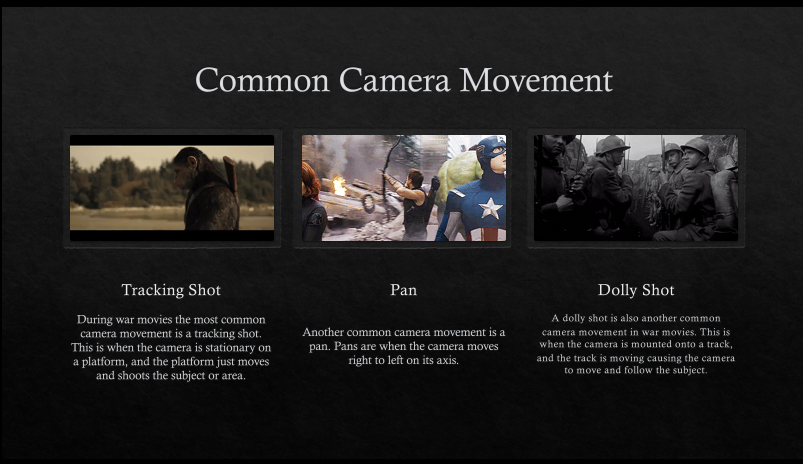
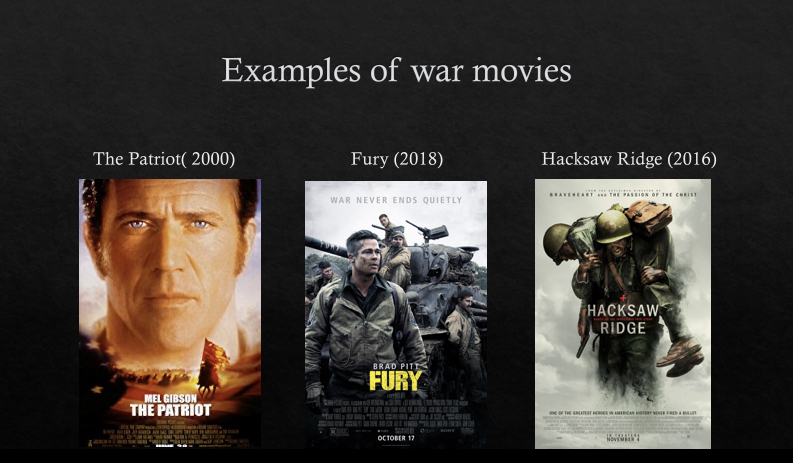
In order to explore and test a different genre, my group members, Aaliyah, Lauren, and Anishkaneel, and I made a PowerPoint on the genre war. In this PowerPoint we discussed all of the aspects that are found within films of this genre. These aspects can be identified as C.A.M.S., mis en scene, editing, and sound. C.A.M.S. stands for camera angles, movements, and shots. In the PowerPoint, we described the most common of each in the genre. Mis en scene is everything that you see that makes up a scene. These can be identified as C.L.A.M.P.S. It stands for costumes, lighting, actors, makeup, props, and setting. When discussing editing, we described the most common ones for the genre; we did the same process when discussing sound. To add on, in the PowerPoint we also discussed the elements that we did and didn’t like. Overall the PowerPoint was a very helpful and constructive tool to help us explore another genre.
Genre Research: The Intruder
The Intruder, a thriller movie made in 2019, is about a young couple (Scott and Annie) that buys their home from a lonely, mysterious widower (Charlie). Trouble arises when we discover that Charlie is too attached to the house and refuses to let it go, then ends up feeling the same way about Annie. He will stop at nothing to get what he wants. This movie is filled with suspense and action. This allows the audience to stay intrigued, alert, and speechless wondering what’s going to happen next.
The camera angles present in this movie are close-ups, medium close-ups, eye level, high- angles, low- angles, and God’s eye. Close- ups were used for n this movie to show the characters emotion to what just happened, like a reaction shot, and to show the intensity of the situation. Medium close- ups were used to show the conversations between the characters and the emotions that came along with them. Eye- level angles were used to capture the realness of the situation. This also applies for high angles, low angles, and God’s eye (aerial). The camera movements present in this movie are zooms, dollies, tilts, pans, and tracking shots. Zooms were used to focus in on the subjects when the scene is calm. Dollies and tracking shots were used in this movie to capture the actions like running and jogging which is very present in this film. Tilts were used to build up the scene by showing the aspects of the scene and the physical characteristics of the subjects, then getting to the main idea or focus of the scene. Pans were used to show the areas that were important to the scene(s). The camera shots present in this film are establishing, two- shots, three- shots, over the shoulder, long, medium-long, medium, point of view, and wide shots. Establishing shots were used to show where the following scene is taking place. Two- shots and three-shots were used to show the main conversations taking place between the main characters. Over the shoulder shots did the same thing, but they also showed the intensity of the conversation. Long, medium- long, and medium shots were used to show the characters’ full physical response and reaction in a scene. Point of view shots were used to show the antagonist’s (Charlie) view when he’s lurking and spying on the couple. Wide shots were used when the scene is calm or uneventful; this is usually followed by a zoom.
There were many aspects that made up the film. These are known as mis en scene. Said aspects are, costumes, lighting, actors, makeup, props, and setting. The costumes in this film are the day-to-day modern wear of average citizens. The lighting in this film is both natural and artificial, but mainly natural. The actors in this movie portray various strong emotions to fit the scene; they come out of there true characters in a remarkable way to get the audience to really feel and understand the direness of the situation. The makeup in this movie starts off simple, like the every day makeup that majority of people wear; this was present on Annie. As the plot thickens the makeup progressively gets gory; it starts with a few bruises, moves to a bloody gash, then ends with both of those combined and an added puddle of blood coming from the antagonist. The main props used in this film were a few shotguns, an axe, a wooden baseball bat, smart phones, and modern cars. This film had many different settings that proved to be important to the scene. These settings include inside and outside of the house, the woods which the backyard of the house led to, the hotel where the antagonist was supposedly residing, an office inside Scott’s work establishment, outside of a bar where Scott was meeting with clients, inside of 3 cars, a cafĂ© where Scott found out information that led to the climax of the film, the closest road to the house, and the hospital. All of these were in the suburbs and city side of Napa Valley, California.
The common edits in the film were cross-cutting, shot-reverse-shot, cutaways, eye-line match, action match, and jump cuts. Cross- cutting was used when the protagonists were talking about the house while leaving the house viewing in the beginning of the movie. While they were discussing their thoughts of the house and their future plans, the antagonist was doing something questionable and heinous in some people’s eyes. This contradicted the original calm, optimistic tone and mood set by the protagonists. Shot-reverse-shots were used to show the magnitude and severity of the situation. Cutaways were used show the thoughts of the antagonist, and events of the past. Eye-line matches were used after a close-up of a character to show what they were looking at. Action matches were used when a characters were describing or doing something in one scene and another character was doing the same thing. Jump cuts were used to show the passage of time. After the couple toured the house and were discussing it, the next scene shows when they move into the house. Later in the movie the holidays change from Thanksgiving to Christmas in the matter of minutes.
The common sounds in this movie were diegetic, non-diegetic, dialogue, voice-over, incidental music, ambient, and sound bridges. The diegetic and ambient are found when the scene takes place outside, like bird chirps and leaves rustling, and inside, like water running and dishes clinking. The non-diegetic sounds can be found in scenes outside, like when there were shots fired outside of the house. The dialogue present in this movie goes from calm to very dramatic and intense. Voice overs are present when the protagonists are having a conversation that relates to the antagonist’s actions in the next scene; this conversation continues into that scene. Incidental music was used to build suspense in the movie, like when one of the characters are about to do or find out something exciting or important to the movie. Sound bridges were used in this movie identity the suspicious sounds being heard. The protagonists would hear a strange sound in one room of their house and go to find out where it is coming from in another room in the house.
The elements that I enjoyed in this movie were the acting abilities of the actors, and the detail that was put into the settings and makeup. The elements that I didn’t like were predictability of the scenes, and the lack of intelligence in the characters’ actions.
The camera angles present in this movie are close-ups, medium close-ups, eye level, high- angles, low- angles, and God’s eye. Close- ups were used for n this movie to show the characters emotion to what just happened, like a reaction shot, and to show the intensity of the situation. Medium close- ups were used to show the conversations between the characters and the emotions that came along with them. Eye- level angles were used to capture the realness of the situation. This also applies for high angles, low angles, and God’s eye (aerial). The camera movements present in this movie are zooms, dollies, tilts, pans, and tracking shots. Zooms were used to focus in on the subjects when the scene is calm. Dollies and tracking shots were used in this movie to capture the actions like running and jogging which is very present in this film. Tilts were used to build up the scene by showing the aspects of the scene and the physical characteristics of the subjects, then getting to the main idea or focus of the scene. Pans were used to show the areas that were important to the scene(s). The camera shots present in this film are establishing, two- shots, three- shots, over the shoulder, long, medium-long, medium, point of view, and wide shots. Establishing shots were used to show where the following scene is taking place. Two- shots and three-shots were used to show the main conversations taking place between the main characters. Over the shoulder shots did the same thing, but they also showed the intensity of the conversation. Long, medium- long, and medium shots were used to show the characters’ full physical response and reaction in a scene. Point of view shots were used to show the antagonist’s (Charlie) view when he’s lurking and spying on the couple. Wide shots were used when the scene is calm or uneventful; this is usually followed by a zoom.
There were many aspects that made up the film. These are known as mis en scene. Said aspects are, costumes, lighting, actors, makeup, props, and setting. The costumes in this film are the day-to-day modern wear of average citizens. The lighting in this film is both natural and artificial, but mainly natural. The actors in this movie portray various strong emotions to fit the scene; they come out of there true characters in a remarkable way to get the audience to really feel and understand the direness of the situation. The makeup in this movie starts off simple, like the every day makeup that majority of people wear; this was present on Annie. As the plot thickens the makeup progressively gets gory; it starts with a few bruises, moves to a bloody gash, then ends with both of those combined and an added puddle of blood coming from the antagonist. The main props used in this film were a few shotguns, an axe, a wooden baseball bat, smart phones, and modern cars. This film had many different settings that proved to be important to the scene. These settings include inside and outside of the house, the woods which the backyard of the house led to, the hotel where the antagonist was supposedly residing, an office inside Scott’s work establishment, outside of a bar where Scott was meeting with clients, inside of 3 cars, a cafĂ© where Scott found out information that led to the climax of the film, the closest road to the house, and the hospital. All of these were in the suburbs and city side of Napa Valley, California.
The common edits in the film were cross-cutting, shot-reverse-shot, cutaways, eye-line match, action match, and jump cuts. Cross- cutting was used when the protagonists were talking about the house while leaving the house viewing in the beginning of the movie. While they were discussing their thoughts of the house and their future plans, the antagonist was doing something questionable and heinous in some people’s eyes. This contradicted the original calm, optimistic tone and mood set by the protagonists. Shot-reverse-shots were used to show the magnitude and severity of the situation. Cutaways were used show the thoughts of the antagonist, and events of the past. Eye-line matches were used after a close-up of a character to show what they were looking at. Action matches were used when a characters were describing or doing something in one scene and another character was doing the same thing. Jump cuts were used to show the passage of time. After the couple toured the house and were discussing it, the next scene shows when they move into the house. Later in the movie the holidays change from Thanksgiving to Christmas in the matter of minutes.
The common sounds in this movie were diegetic, non-diegetic, dialogue, voice-over, incidental music, ambient, and sound bridges. The diegetic and ambient are found when the scene takes place outside, like bird chirps and leaves rustling, and inside, like water running and dishes clinking. The non-diegetic sounds can be found in scenes outside, like when there were shots fired outside of the house. The dialogue present in this movie goes from calm to very dramatic and intense. Voice overs are present when the protagonists are having a conversation that relates to the antagonist’s actions in the next scene; this conversation continues into that scene. Incidental music was used to build suspense in the movie, like when one of the characters are about to do or find out something exciting or important to the movie. Sound bridges were used in this movie identity the suspicious sounds being heard. The protagonists would hear a strange sound in one room of their house and go to find out where it is coming from in another room in the house.
The elements that I enjoyed in this movie were the acting abilities of the actors, and the detail that was put into the settings and makeup. The elements that I didn’t like were predictability of the scenes, and the lack of intelligence in the characters’ actions.
Friday, January 17, 2020
Continuing Final Project
After much consideration, my group members and I have narrowed it down to two pitches. We did this by discussing the pros and cons of them all. We chose them from three total. The first pitch is a horror film, and it was created by Lauren. The plot is about all of the most infamous antagonists in horror movies team up to spread wickedness and cause both physical and mental destruction in the world. Examples of the most infamous antagonists are Dracula, Frankenstein, and Pennywise. The second pitch is a suspense/thriller, and it was created by Aaliyah. The plot is about a bridesmaid that is obsessed with the bride who happens to be her twin sister. The bridesmaid has a twisted, sinister desire to take her sister’s life, and will let nothing get in her way. The third and final pitch is a murder-mystery/ thriller created by me. The plot is about a demented person going on a killing spree. He or she kills all of those that commit the 7 deadly sins. Ideally the killer would be someone close to the victims since they would know for sure that they have committed the sin. The two that we have narrowed it down to are Lauren’s and mine.
The first pitch that we have decided on is Lauren’s pitch about the most infamous antagonists coming together to wreak havoc on the world. There are many pros to her pitch. It can bring all generations together since it features villains from different decades that they are all familiar with. The idea of combining popular characters that share a common goal is very popular amount audiences. Lastly, provides an opportunity for famous protagonists or even a new protagonist(s) to surface. There was one con that I could think of that would put a huge dent in our film. This con is copyright. The infamous antagonists are not our original characters, and we don’t have permission to use them. The other cons aren’t as major, but still a big deal. One is that it sounded too much like the movie Goosebumps and it’s sequel Goosebumps 2. The other one is that special effects and makeup for certain characters would be very difficult for us to do.
The second and final pitch that we have decided on is my pitch about a serial killer killing all of those who commit the 7 deadly sins. There are many pros to my pitch as well. It’s something that my group members haven’t seen before. We can easily get the message across in the opening credits. It doesn’t require complex special effects and makeup. Lastly, the plot would make the movie more compelling and get more attention because it will spark conversations about what’s morally wrong or right. There weren’t any cons that my group members could think of, but there were was one that I thought of. I’ve had this pitch of a movie since I was in elementary or middle school, and a few years ago someone did something similar on a show. Though in the end this is an uncommon, creative, and chilling pitch that we are excited to film.
As you can infer, my group members and I decided to go with my pitch.
Starting Final Project
When first entering this class I knew very little about what it took to create a film. The most I knew was a little of how to distribute and about 1/3 of how to edit it. Then, once I began the class I went from brainstorming ideas, filming, and editing a commercial, music video, and soon a movie. Throughout these projects there has been a lot of ups and downs. For instance, when we were filming the commercial we ran out of time on the first day to film all of the scenes, we didn't have a few of the main props, and the laptops that we received kept dying. Another example would be when we were filming our music video. We went completely off our storyboard. Moving on to a more positive note, we really enjoyed filming our music video, and it came out better than we imagined. As for the commercial, even though it wasn’t the best, we got to relive our childhood. We’ve already began planning for our final project, the movie, and are very optimistic.
In this class I have learned majority, if not all, of the many aspects that go into creating and distributing a film. I have learned about all of the basics and all of the camera angles, movements, shots, mis en scene, editing, sound, and the 5 phases of film making. The basics include a take, scene, shot, shooting, subject, computer general imaging (CGI), script, storyboarding, treatment, and funding. The camera angles that I’ve learned are eye-level, high angle, low angle, and oblique/dutch/canted. The camera movements I’ve learned are pan, flash pan, tilt, tracking shot, zoom, and handheld. The camera shots I’ve learned are establishing, wide, long, medium- long, medium, medium close- up, close up, extreme close-up, two-shot, three shot, aerial/God’s eye/ bird’s eye, point of view, over the shoulder, trunk, stock, and crane. Mid en scene is everything that you see that makes up the scene. This consists of C.L.A.M.P.S ( costume, lighting, actors, makeup, props, and setting). The edits that I’ve learned are cross- cutting, split screen, cutaway, insert, dissolve, fade in, fade out, shot reverse shot, eye-line match, graphic match, jump cut, burn in, burn out, iris in, iris out, reaction shot, and wipe. The different sounds I’ve learned are diegetic, non- diegetic, folcy, sound bridge, sound motif, dialogue, voiceover, soundtrack, score, incidental music, and ambient sound. The 5 phases of film making are development, pre-production, production, post-production, and distribution. Two talents that I learned are how to put together scenes and edit them.
When creating a movie you must first start of with a pitch. A pitch is a Hollywood term to describe an idea where a film is encapsulated in 25 words or less. Usually with one sentence. My group members, Anishkaneel, Aaliyah, and Lauren, and I have come up with 3 pitches for a movie. The first pitch is a horror film, and it was created by Lauren. The plot is about all of the most infamous antagonists in horror movies team up to spread wickedness and cause both physical and mental destruction in the world. Examples of the most infamous antagonists are Dracula, Frankenstein, and Pennywise. The second pitch is a suspense/thriller, and it was created by Aaliyah. The plot is about a bridesmaid that is obsessed with the bride who happens to be her twin sister. The bridesmaid has a twisted, sinister desire to take her sister’s life, and will let nothing get in her way. The third and final pitch is a murder-mystery/ thriller created by me. The plot is about a demented person going on a killing spree. He or she kills all of those that commit the 7 deadly sins.
In this class I have learned majority, if not all, of the many aspects that go into creating and distributing a film. I have learned about all of the basics and all of the camera angles, movements, shots, mis en scene, editing, sound, and the 5 phases of film making. The basics include a take, scene, shot, shooting, subject, computer general imaging (CGI), script, storyboarding, treatment, and funding. The camera angles that I’ve learned are eye-level, high angle, low angle, and oblique/dutch/canted. The camera movements I’ve learned are pan, flash pan, tilt, tracking shot, zoom, and handheld. The camera shots I’ve learned are establishing, wide, long, medium- long, medium, medium close- up, close up, extreme close-up, two-shot, three shot, aerial/God’s eye/ bird’s eye, point of view, over the shoulder, trunk, stock, and crane. Mid en scene is everything that you see that makes up the scene. This consists of C.L.A.M.P.S ( costume, lighting, actors, makeup, props, and setting). The edits that I’ve learned are cross- cutting, split screen, cutaway, insert, dissolve, fade in, fade out, shot reverse shot, eye-line match, graphic match, jump cut, burn in, burn out, iris in, iris out, reaction shot, and wipe. The different sounds I’ve learned are diegetic, non- diegetic, folcy, sound bridge, sound motif, dialogue, voiceover, soundtrack, score, incidental music, and ambient sound. The 5 phases of film making are development, pre-production, production, post-production, and distribution. Two talents that I learned are how to put together scenes and edit them.
When creating a movie you must first start of with a pitch. A pitch is a Hollywood term to describe an idea where a film is encapsulated in 25 words or less. Usually with one sentence. My group members, Anishkaneel, Aaliyah, and Lauren, and I have come up with 3 pitches for a movie. The first pitch is a horror film, and it was created by Lauren. The plot is about all of the most infamous antagonists in horror movies team up to spread wickedness and cause both physical and mental destruction in the world. Examples of the most infamous antagonists are Dracula, Frankenstein, and Pennywise. The second pitch is a suspense/thriller, and it was created by Aaliyah. The plot is about a bridesmaid that is obsessed with the bride who happens to be her twin sister. The bridesmaid has a twisted, sinister desire to take her sister’s life, and will let nothing get in her way. The third and final pitch is a murder-mystery/ thriller created by me. The plot is about a demented person going on a killing spree. He or she kills all of those that commit the 7 deadly sins.
Thursday, December 5, 2019
Music Video: Editing
On December 3rd and 5th, my group members and I edited our music video. Though, it was one group member in particular that did all of the editing. This group member was Lauren. The rest of us guided and gave our input and suggestions. The editing was done on her MacBook Air laptop in class. First we dumped the footage onto her laptop. We did this using an SD Card reader and a plugin extension. Once the footage was dumped it was exported to a video editing application. This application is called iMovie. Once all of the footage loaded, it was time to edit.
There were many takes of the same scene. We all sat together and assessed all of the different takes we had. We did this to make sure that we all agreed on which takes we likes the most. Starting with the first scene, there were three different takes of this scene. The first one had all of us in it, the second had three of us in it, and the third had two of us in it. That was the only difference between the takes. We decided to go with the first one. The second scene was more of an individual decision since it showed us singularly. The third, forth, and fifth scenes didn’t really appeal to us; so, it wasn’t difficult to choose which takes we wanted to use. For scenes six through fifteen there was only one take since we were satisfied with what we shot. We had no choice but to use what we had. Finally for the last scene there were five takes and we decided to go with the second one.
As I previously mentioned in my other blogs regarding this music video, my group members and I wanted to add in different transitions and special effects. We feel as though the use of these will make our video more unique, creative, and interesting. The transitions that we used were swipe, spin in, spin out, circle close, mosaic, and swap. The special effects used were slow motion and high speed. There are more effects that we want to add in though. These are the led animation effect and the melting words effect for the title. I will be doing these effects on my laptop on another video editing application. Even if I don’t accomplish this I know that the music video will be a knockout.
There were many takes of the same scene. We all sat together and assessed all of the different takes we had. We did this to make sure that we all agreed on which takes we likes the most. Starting with the first scene, there were three different takes of this scene. The first one had all of us in it, the second had three of us in it, and the third had two of us in it. That was the only difference between the takes. We decided to go with the first one. The second scene was more of an individual decision since it showed us singularly. The third, forth, and fifth scenes didn’t really appeal to us; so, it wasn’t difficult to choose which takes we wanted to use. For scenes six through fifteen there was only one take since we were satisfied with what we shot. We had no choice but to use what we had. Finally for the last scene there were five takes and we decided to go with the second one.
As I previously mentioned in my other blogs regarding this music video, my group members and I wanted to add in different transitions and special effects. We feel as though the use of these will make our video more unique, creative, and interesting. The transitions that we used were swipe, spin in, spin out, circle close, mosaic, and swap. The special effects used were slow motion and high speed. There are more effects that we want to add in though. These are the led animation effect and the melting words effect for the title. I will be doing these effects on my laptop on another video editing application. Even if I don’t accomplish this I know that the music video will be a knockout.
Monday, December 2, 2019
Filming blog #2
It’s a wrap! The filming for our music video is completed and the next step is editing. We began and completed filming on November 27th. The filming process was both fun and challenging. The message that we were trying to portray in the video was to just let loose have fun with the people you love. This made it really easy to shoot and act in the scenes. The actresses, my group members and I, are all friends and enjoy each other’s company. Anytime we’re together we have a blast. There weren’t any major challenges. Any challenge that we had we overcame. One of them was that one of our group members Lauren was on crutches, but we solved this problem by renting a mall cart and pushing her around in it throughout the mall. For certain scenes when she needed to stand there wasn’t an issue because she could stand up for a short period of time.
At the first location, Lauren’s house, everything went as planned. We followed the story board and got our scenes filmed fast. However, at the second and final location, Sawgrass Mills Mall, we did not follow majority of our storyboard. For the scene in the parking garage we decided to do a pan in the elevator of the parking garage instead of the lot. Though, we were still dancing. The scene that took place outside of the mall with us walking in on the cross-walk, became a tracking shot instead of an eye- level shot. In the next scene, we walked through one of the big light up ornament on display. In the next scene, we went inside of the mall and went to the store Hot Topic. When we went inside of this store the manager said that we couldn’t film so all we did was an establishing shot of the outside. We also did an establishing shot of the store H & M. In the next scene we went to Bed Bath & Beyond. In this store we filmed one of our group members laying down and relaxing on one of the display beds. Another group member lightly jumped on the same display bed. In the next scene, we went to the food court and took an establishing shot of a couple of restaurants. In the next scene, we went to the store Target. In this scene two of us had a “sword fight” with the gift wrapping paper and pushed on of our group members Lauren, who was on crutches, on the mall cart down an aisle. In the next scene we went to the arcade In the Game and played basketball and pretended to another game. In the next scene, we went back on track with our storyboard and did the water fountain jump. Then in the final scene we went back to the first location and pretended that it was all a dream. This scene was a wide shot showing all of us.
Subscribe to:
Posts (Atom)
Audiences and Institutions Essay
6. To what extent is digital distribution vital to the media area you have studied In a world where different technological innovations ...
-
Now that we have chose our song, it is time that we plan how the music video is going to play out. The aspects that we need to consider are ...
-
It’s a wrap! The filming for our music video is completed and the next step is editing. We began and completed filming on November 27th. The...
-
Today my group members and I started and completed our storyboard. In the first scene, the commercial opens up with an establishing shot. In...